Let's analyze the golf swing for a minute. There are actually three phases to the golf swing, each of which can cause injury if executed incorrectly. Additionally, there are specific exercises you can perform to help reduce your risk of hurting yourself during that particular swing phase.
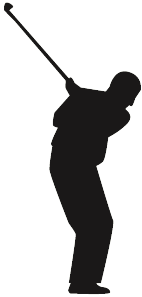
Phase 1: Take-Away. The take-away consists of the set-up movement to the top of the back swing. During this phase, the most common potential injuries involve the thumb and wrist, particularly on the lead hand. Here is an effective workout for the muscles of the wrist, hand and forearm. To begin, stand with your feet shoulder-width apart holding a 5-pound dumbbell in your right hand. Keeping your arm to your side and using only your wrist, raise the dumbbell as high as you can and lower it as far as you can. Do two sets of 25 reps. Next, do another two sets of 25 reps, but while moving your wrist from side to side as far as you can. Repeat this entire workout with the dumbbell in your left hand.
An advanced workout for your wrists would be to take a barbell/dumbbells with a weight you can handle, anywhere from 10-45 pounds, and do three exercises (known as a "tri-set") back to back to back without rest. Start with your feet shoulder width apart and grab the weight with your hands facing down, shoulder-width apart, held which each thumb. Reverse curl the weight up toward your body, flexing the forearm as you finish the movement at the top. Do 10 reps.
Next, hold the weight behind you, palms facing up and even with your gluteus maximus (your buttocks). The back of your hand should be touching the top of your buttocks. Raise the weight as high as you can without moving your arms; use your wrist only for 10 reps.
Finally, sit down on the bench and rest your forearms on your thighs. Do not allow your wrists to rest on your knees. Hold the weight with your palms up and move only your wrist vertically for 10 reps. Do not rest and perform another tri-set, but this time do 12 reps, and then finish the last set with 15 reps. Another option is to pyramid: increase the amount of weight while decreasing the number of repetitions. For example: 10 pounds for 15 reps, 12 pounds for 12 reps, and 15 pounds for 10 reps. There is an inverse relationship at play here: As you add more weight, you do less reps.

Phase 2: Impact. The next phase of the swing is the impact, which consists of the downswing and impact with the ball. The most common injuries during this phase are attributable to stress on the back knee and compression forces acting on both wrists. Additionally, the lead elbow and hand/wrist are often hurt during impact.
In terms of exercises that can help prevent these injuries, leg extensions/leg curls and abduction/adduction exercises (almost all fitness clubs have equipment for these types of exercises), along with regular stretching and massage, are extremely effective for the legs. Triceps pushdowns using a reverse grip with the hands up is an excellent exercise for the triceps and will help to prevent injury to the elbows. High-intensity training (one set to muscle exhaustion for each exercise, using slow, deliberate movements) works well and is a safe method of training for all the exercises above. For the legs, do 15-20 reps; for the triceps/elbows, do 8-12 reps.
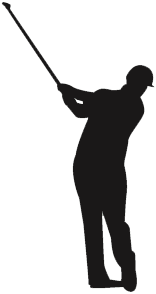
Phase 3: Follow-Through. Finally, there is the follow-through after impact. During this phase there is abdominal torque and risk of spinal injury. I recommend training the oblique muscles (essentially the sides of the abdomen) using a trunk rotation machine, twisting slowly in a circular fashion for 20-25 reps, and a lower back extension machine for 15-20 reps. Do not use heavy weights for these exercises and make sure to do them slowly and eliminate momentum. These exercises will help strengthen the core muscles and help prevent back injuries.
